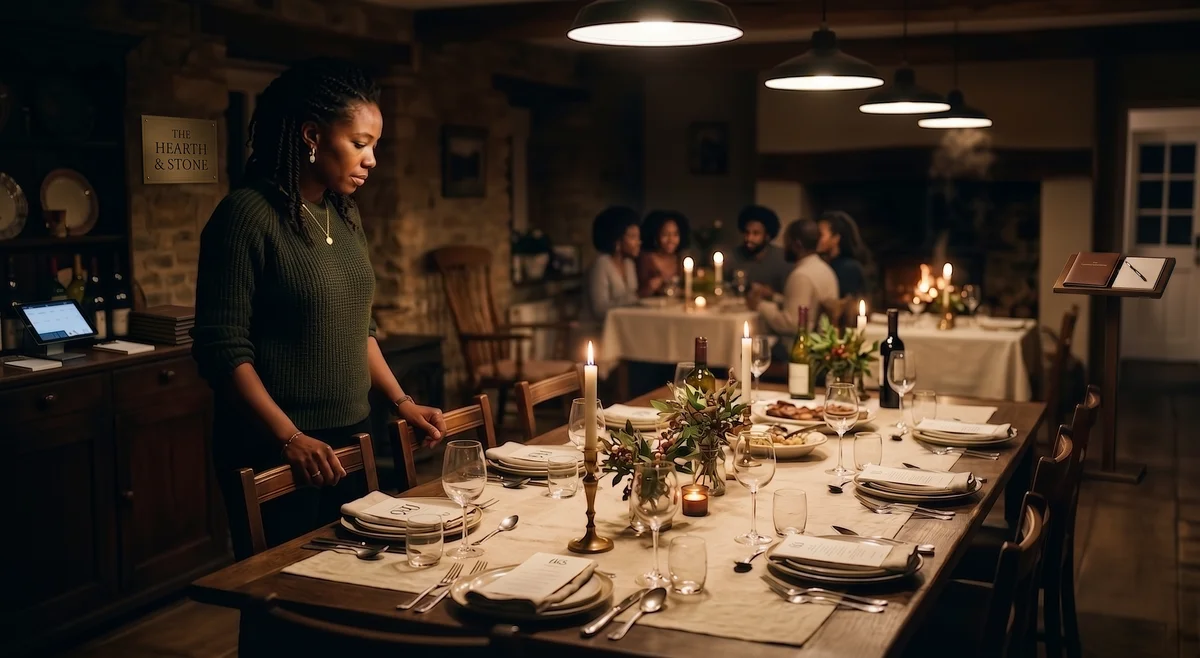
There is a moment, maybe ten minutes before everyone arrives, when the room is still yours alone. You have chosen the table, the long one, the one that will require people to lean across one another to make a point, to pass something without asking. You have chosen it deliberately, the way you choose everything that matters in the diaspora: not by accident, not by convenience, but by a kind of low-grade insistence that the night be what it needs to be. And you feel, already, the particular rightness of having gotten this part correct.
This is not home. You know that. But it is something the diaspora has quietly learned to build, a category of place that sits just adjacent to home, that borrows its grammar without pretending to be the original text. The smell is part of it, the specific register of spice and char and something slow-cooked that got going well before you walked in. The sound is part of it too, voices in the language, or near it, moving at a different pace than the city outside, unhurried in a way that feels like permission. You settle into it before anyone else arrives, and what you feel is not nostalgia, which is a backward-facing ache, but something more like recognition. Here. This. Still.
The choice of where to eat, when the gathering matters, is never really just about the food. It is an argument you are making about who the people around that table are to each other. When you choose a place that centers the culture, that does not sand down its edges for an outside gaze, that is not performing heritage as novelty or offering it as translation, you are saying something specific to the people you are about to share a meal with. You are saying: this is not incidental to us. You are saying: I see you whole.
That act of seeing is what the best of these spaces make possible. Not the restaurant as a backdrop, not the café as a convenience, but the eating space as a room where culture does not have to explain itself. Where the menu is not a glossary. Where the person who has never made the crossing but carries the inheritance anyway can sit down and feel the coordinates of something older than their own life clicking quietly into place beneath them.
What the food does in those rooms is do two things at once. It binds horizontally, across the table, present tense, between the person who flew in last month and the person who was born here and has never left, between the eldest who remembers and the youngest who is only beginning to ask. And it binds vertically, down through every iteration of this dish, this combination, this particular argument about whether the heat should come from here or there, answered tonight by someone who learned it from someone who learned it in a kitchen that no longer stands. Both bindings are happening simultaneously, over a single shared plate.
You cannot replicate that in a room that doesn't honor it. The food might be technically similar. The ingredients might even be right. But something in the register shifts when the space itself is uncertain about what it is hosting, when it holds the culture at arm's length, when it makes the food the interesting thing rather than the real thing. The gathering changes in kind, not just in flavor. People are pleasant, and the evening is fine, and something goes unmade.
There is a particular fullness that arrives at a long table an hour or so after the food. Plates pushed back or scraped clean, depending on the generation and the upbringing, voices crossing one another freely, the conversation having moved from the deliberate to the unguarded. Someone is making a point with their hands. Someone else is already reaching toward whatever is left. This is what it was always going to be, you think. This is what the choosing was for.
The communities that form in the diaspora are amazing and layered things. They are not the communities that formed back there, structured by proximity and deep shared history and the particular texture of having grown up in the same fifty square miles. They are communities of election, partly, people who chose each other across difference, who found each other through the shared coordinates of origin and then discovered, across enough shared tables, that they also liked each other. Those friendships and those family gatherings reconstituted across generations need the food to do its work precisely because so much else has been interrupted. The food is the thread that runs through all the interruptions.
And the spaces that honor that thread, the ones that understand what they are actually holding, that commit fully rather than hedge, those spaces become something more than businesses over time. They become the room where the newly arrived understand that arrival is possible, where the long-settled remember who they were before they got so fluent in being somewhere else. They become the coordinates of a community's ongoing life, the places where milestones accumulate without ceremony, where you don't have to explain why this matters because the room already knows.
Someone will ask, later, why you chose this place. You will say something abbreviated, it's good, it's the right kind of thing, because the full answer takes longer than the question was inviting. The full answer is that you chose it because the culture deserved a room that would hold it without reducing it, and because the people coming deserved to spend an evening where they did not have to translate themselves, and because you have learned, over years of gathering in places that almost got it right, that almost is not nothing but it is also not enough.
The choice of where to eat, when it is made with intention, is an act of recognition. Of the food, yes, always, first, the food. But also of the people carrying it forward, the tradition moving in real time through this room, through these particular hands passing this particular plate, tonight, in a city that had no part in making any of it, and yet here it is, whole and undiminished, still entirely itself.
You made the choice. The room held it. Everyone arrived. That is not a small thing.
Find Your Roots, Feed Your Soul
Stay in the know.
New guides, hidden gems, and dishes that define us — delivered to your inbox. No spam, ever.