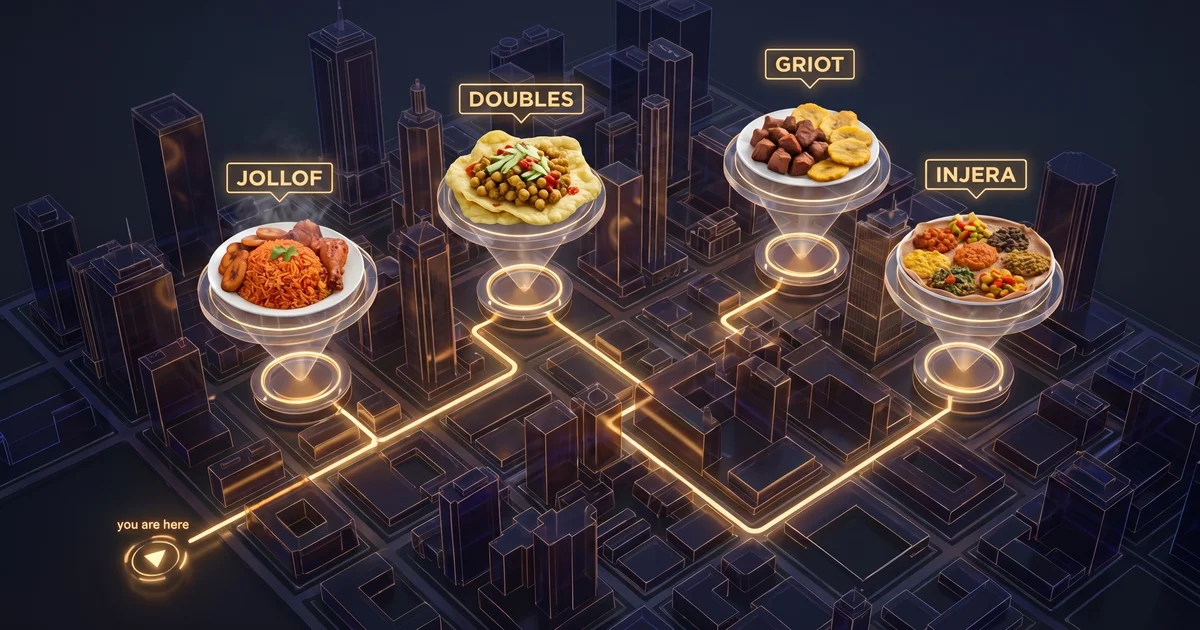
The pot has been on. That is the first thing to understand. Whatever you have been missing, the jollof that carries a specific Sunday in its smoke, the pepper soup that exists nowhere in your memory except at a particular table with particular people, the griot fried to that precise register between crisp and yielding, the doubles with the exact shadow of heat your grandmother's had, it has been cooking. Two neighborhoods away, maybe less. The restaurant has been open. The cook has not been hiding. The thing you have been homesick for, in that particular way you can be homesick inside a city you already live in, has been real and close and waiting.
You just couldn't find it.
On June 19, 1865, a Union general stood in Galveston, Texas, and read out the order: enslaved people were free. The Emancipation Proclamation had been law for two years and six months. The freedom was not new. It had existed since the first day of 1863, legally, on paper, already theirs. Thirty months passed between the thing being true and the people it belonged to ever learning it was true. The delay was not administrative. It was enforced, deliberately, at cost, by people who understood exactly what they were withholding and why. The gap between real and known is never neutral. It is always held open by something.
That is what Juneteenth carries. Not just the arrival of freedom, but the full weight of everything that filled the distance between the law and the news of it. The celebration is real and enormous. And underneath it, steady as a foundation, is the knowledge that truth can coexist with unreached for a very long time, and that the coexistence is never accidental.
The gap that Kokoye was built to close is not that gap. Nothing is. But the structure of it recurs, the thing that is present, that is real, that belongs to specific people, failing to arrive, and it recurs in forms that look ordinary until you are the one living inside them.
Here is the ordinary version. You are in a city with a significant Ghanaian population, or Trinidadian, or Haitian, or Ethiopian, or Jamaican. The restaurants exist. Some of them have been open for a decade, cooking through everything, held together by a community that knows exactly where they are and what they mean. You are part of that community, or adjacent to it, or you are simply a person who grew up eating injera and now lives somewhere new and would give a significant amount to find the version that tastes like your mother's. You search. You type the name of the thing you want, not "ethnic food," because that category was built by and for people who are outside the cuisine looking in, and you are not that person; you are searching for the specific dish by its actual name. And the algorithm returns nothing useful. Or it returns the wrong thing. Or it returns a list in which what you are looking for does not appear, because the systems that surface restaurants were built on assumptions about which restaurants need surfacing, and those assumptions have blind spots, and the blind spots are not random.
The restaurant is there. It has been there. The oxtail is on. You just have no way to close the last few blocks.
There is a strange loneliness in this that is hard to name because it does not look like what loneliness is supposed to look like. You are in a city. You are surrounded by people. The food you need is physically nearby. And still there is this gap, not absence, not distance, just a failure of connection that should not exist and keeps existing anyway. The infrastructure built to link people to restaurants was not built with your hunger as the use case. It was built for a customer the engineers had in mind, and you can tell a lot about who that customer was by what gets returned when you search.
Kokoye exists because that failure is not inevitable. The gap is not the natural state of things. It is the result of specific choices about which restaurants matter enough to index properly, which cuisines deserve their own categories rather than being flattened under a single tag that means food from somewhere we consider foreign, which names are worth recognizing when someone types them into a search. Those choices can be made differently. The map can be drawn to include what has been left off it.
What that means, practically, is this: a restaurant cooking suya and egusi and puff-puff can be found by the person searching for suya and egusi and puff-puff. A spot doing real Haitian griot, not "Caribbean" as a vague gesture, but griot, by name, can appear in front of the person who knows what griot is and has been looking for it and has been finding nothing. The chef who has been excellent for years without being found can be found. Not by being renamed into a category designed for outsiders, but by being exactly what they are, in the terms that the people who grew up on the food actually use.
The freedom was already law. The food is already there. The question that Juneteenth holds permanently open, the question that has teeth in it, is what it costs to live inside the gap while you wait for the news to arrive. What it costs the people who are free and don't know it. What it costs the restaurant that is open and excellent and invisible to the systems that are supposed to make things findable. What it costs to be real and present and still unreached.
The news finally reached Galveston on June 19, 1865. It should have reached them on January 1, 1863. The distance between those two dates belongs to history, and to grief, and to the people who observed Juneteenth long before it became a federal holiday because they understood what they were marking.
The smaller distance, the one measured in city blocks, in failed searches, in the cuisine that exists and the person craving it who cannot find each other, that one can be closed now. Not as a gesture toward the larger history. Not as a metaphor. As its own thing, which matters on its own terms, because the pot has been on, and you have been hungry, and there is no good reason the news should take this long to arrive.
So consider this the news arriving. The map has been redrawn to take in what was always there, your city is on it now, and the table you have been looking for is closer than the search bar ever let you believe. Come and find it.
Find your roots, feed your soul.
Stay in the know.
New guides, hidden gems, and dishes that define us — delivered to your inbox. No spam, ever.